
Yes, tattoos hurt more over bone than over muscle or fat, in most cases. Where you get inked changes the sensation far more than the design does.
The tissue under your skin decides how much of the needle you feel. Fat and muscle cushion the work, while bone leaves the skin with nowhere to go.
This guide explains what the needle does at each depth and why bony areas feel so different. It also covers how topical anaesthetics interrupt pain signals so you can plan a more comfortable session.
Before comparing bone, muscle and fat, you need to know where the needle goes. It goes shallower than most people think.
Skin has two main layers. The epidermis is the thin outer layer that sheds constantly, and the dermis sits beneath it. Tattoo ink has to sit in the dermis, which averages about 1 to 3 mm thick, so it stays put for life.
Ink placed too shallow fades and falls out. Ink placed too deep can end up in the fatty layer below, where lines blur and pain increases.
The dermis is rich in blood vessels and nerve endings. Tattoo machines typically move the needle in and out around 80 to 150 times a second, and the needle often contacts those nerve endings.
Each pass triggers pain signals. They travel along your nerve pathways to your brain, which is why the sensation is a sharp, repeated sting or scratch.
So the needle never reaches your bones or muscles. What changes from place to place is the material around the dermis, and how much of the needle’s energy reaches your nerves.
Yes. Bony areas rank among the most painful placements on every credible pain chart, and this is why.
Where bone sits just under the skin, there is very little fat or muscle between the needle and your nerves. Healthline’s summary is that bony areas usually hurt a lot, while the least painful places have the most fat and thickest skin.
Thin skin also means the dermis is compressed against something hard. Nothing absorbs the impact.
Artists often describe a rattling feeling over shins, ankles, ribs and the sternum. The machine’s vibration moves through the bone, so you feel it in more than the spot being worked.
That’s why the discomfort can seem to spread beyond the tattoo itself.
Over muscle or fat, skin gives a little under the needle. Over bone, it can’t. Artists also stretch the skin tight to get clean lines, which makes thin, bony areas feel even sharper.
Removery’s survey of tattooed people found respondents rated the ankles and shins as the most painful places, because the skin is thin and the bones lie so close to the surface.
Some bony spots also carry extra nerves. The knee ditch, for example, has the sciatic nerve running under very thin skin, and Saniderm ranks it at the top of its pain chart.
Usually not. Muscle gives the skin firm support and a thicker buffer, so the needle feels muffled rather than sharp.
That’s why the outer thigh, outer upper arm and outer forearm feature on almost every “least painful” list. Hyper Inkers rates the outer thigh around 3 out of 10, compared with 8 for the inner thigh.
There are two catches.
Fat is generally kind to tattoo clients. It cushions the dermis and has fewer nerve endings, so areas with more padding, such as the outer thigh, hips and stomach for some people, often feel easier.
Two things complicate the picture.
Body composition varies. The same stomach or hip can feel very different from person to person. Tattoo pain also changes across body types, and some areas rank differently for women and men, with the stomach and breasts often more sensitive for women.
If the needle goes too deep and reaches the fatty layer under the dermis, pain increases and lines can blur. This is where artist skill counts. A steady, consistent depth keeps the work in the dermis, where the ink belongs.
An artist working over fat isn’t at the mercy of bone vibration, but a heavy hand still hurts.
| Tissue under the skin | Cushioning | Typical pain | Common areas |
|---|---|---|---|
| Bone | Very little | High | Ribs, spine, shins, ankles, sternum |
| Muscle | Good | Low to moderate | Outer thigh, outer arm, calf |
| Fat | Very good | Low to moderate | Hips, outer thigh, upper stomach |
Treat this as a rule of thumb, not a guarantee. Nerve density, skin thickness and your own tolerance all change the result.
Tissue is the biggest factor, but not the only one.
Understanding the science of pain makes it clear how numbing products help. Instead of changing what the needle touches, they change what your nerves can report.
Pain travels as an electrical impulse along a nerve. To fire, the nerve relies on sodium channels opening and letting sodium into the cell.
Local anaesthetics such as lidocaine block those voltage-gated sodium channels. That prevents sodium entering the cell and stops the impulse being transmitted. With the signal cut, your brain receives far less pain information from the area.
Your skin still feels pressure and movement. What fades is the sharp, stinging part.
Check the ingredient list on any numbing product you use so you know exactly what you’re applying.
Numbing works best on the surface nerves in the skin. Over bone, vibration and pressure still travel through the tissue, and a session over ribs or shins often runs long. As the first application wears off, the pain returns.
That’s why a two-step approach makes sense for bony placements.

Prep starts before you sit in the chair. A numbing cream applied ahead of time gives the anaesthetic time to work into the skin.
No Tears Numbing Cream is a tattoo-specific formula. The brand describes it as fast-acting, with relief that lasts for hours, so it suits long or detailed sessions. It costs £18.00 in the No Tears shop.
Apply it as directed on the pack and check with your artist first. Do a patch test beforehand, too.
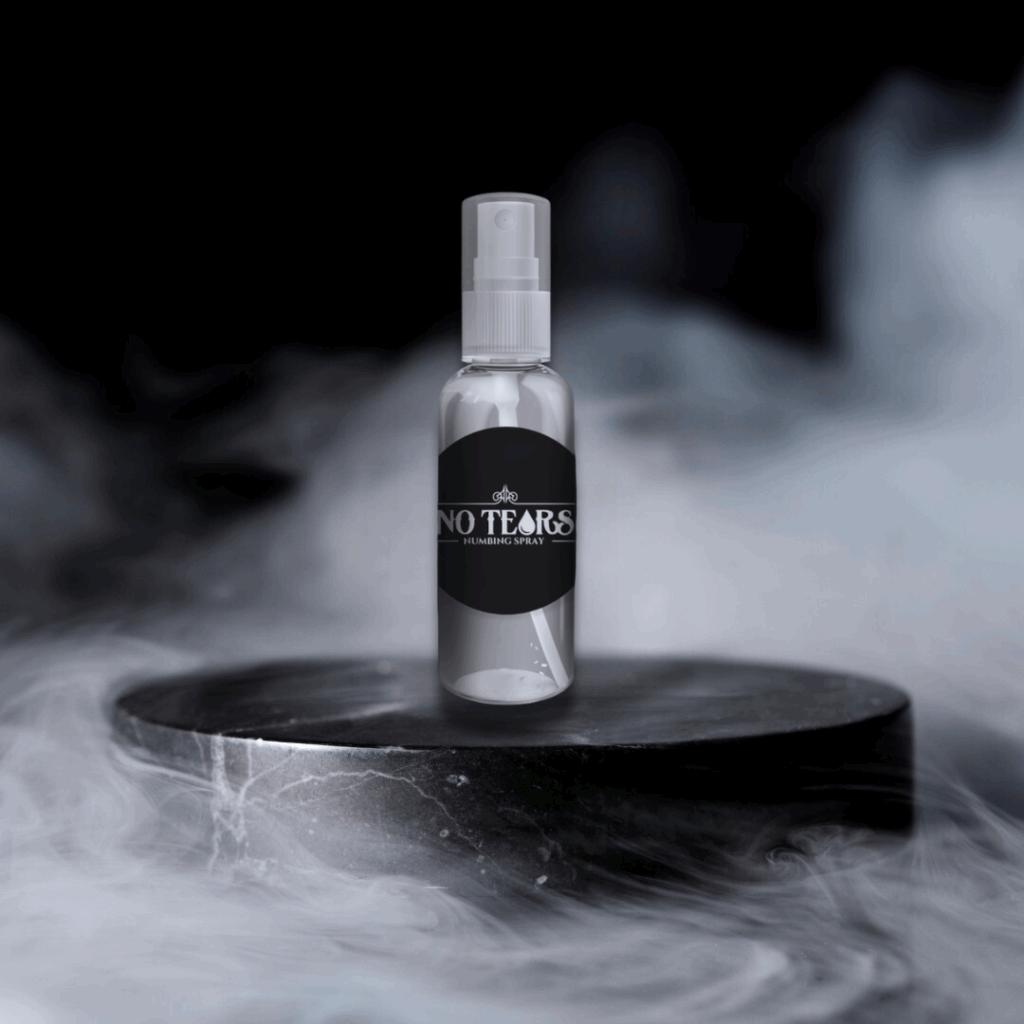
Even the best cream fades, and it tends to fade just as the artist reaches the hardest part. That’s especially true over ribs, spine or ankles, where bone puts you under the most strain.
The No Tears Mid-Procedure Tattoo Spray is made for this moment. You apply it during a break, so you can carry on without leaving the chair. The brand says it is fast-acting and can also help with swelling, and it’s currently £19.50, reduced from £22.50.
If you want both, the cream and spray bundle costs £34.99.
Not every artist allows sprays mid-session, so agree it with them beforehand.
Want to know what to expect on specific spots? The No Tears blog has guides on spine tattoo pain and back tattoo pain.
Tattoos hurt more over bone than over muscle or fat. The needle only reaches the dermis, but thin skin, tight tissue and vibration make bony areas feel far sharper.
Muscle and fat cushion the work, so outer thighs, upper arms and the upper back are the easier choices. Depth and technique still matter over soft tissue.
If your design belongs on a bony spot, you don’t have to skip it. Prepare with a numbing cream, keep a spray ready for when it fades, and talk it through with your artist beforehand.
Yes. Thin skin, little padding and vibration through the bone make bony areas some of the most painful placements.
No. The needle only reaches the dermis, about 1 to 3 mm deep. The bone is under thin skin, so you feel the vibration and pressure.
Usually. Muscle adds cushioning, so areas like the outer thigh and outer arm tend to feel milder. Tensing up can make it feel sharper.
Not usually. Fat cushions the skin and has fewer nerve endings. Pain rises if the needle goes too deep or if the area is otherwise sensitive.
Topical anaesthetics such as lidocaine block sodium channels in your nerves, which interrupts the pain signal on its way to the brain.
Many artists allow it during breaks, but ask first. You can see the No Tears Mid-Procedure Spray here.
For long sessions over bony areas, many people use cream before and spray during. The brand offers a bundle for that.