
Every tattoo hurts a little. The real question is how much, and that depends mostly on where you put it.
Placement decides more about your pain than your tolerance, your artist or your design. Two people can sit for the same hour of work and describe completely different sessions because one chose an outer thigh and the other chose the ribs.
This guide ranks the most common tattoo spots from least to most painful. You’ll also see why certain areas hurt more, and what you can do before you book.
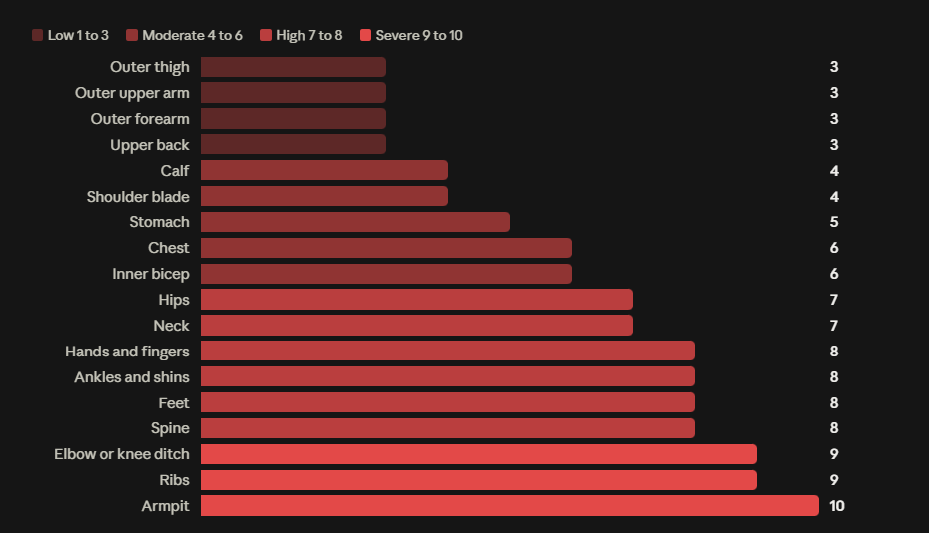
A tattoo needle punctures the top layer of your skin thousands of times a minute. What you feel depends on what sits underneath that patch of skin.
Healthline’s summary is simple. The least painful places have the most fat, fewest nerve endings and thickest skin, while the most painful have the least fat, most nerve endings and thinnest skin. Four factors explain almost every ranking on the chart.
Your hands, feet and armpits are packed with nerve endings because they need to feel fine detail. More nerves means more signals reaching your brain per pass of the needle.
The palms and soles are the extreme case. They are covered in nerve endings and are among the most painful places to be tattooed, and they don’t hold ink well either.
Thin skin over bone gives the needle nowhere to go. The vibration travels through the bone, which is why shins and ankles feel sharp and rattling.
In Removery’s survey of tattooed people, respondents rated the ankles and shins as the most painful places, because the skin is thin and the bone sits so close to the surface.
Fat and muscle act as padding. Where that padding is missing, the needle feels closer and the sensation is sharper. Ribs on a slim frame are a classic example.
Some areas move constantly. Your ribcage expands with every breath, and your elbows and knees bend all day. Artists also stretch the skin tight to get clean lines, which can make already sensitive spots feel worse.
These spots suit first-timers and anyone planning a long session. You’ll feel a scratching or burning sensation, but it stays manageable.
The outer thigh has plenty of muscle and fat and very few nerve endings. Hyper Inkers rates it around 3 out of 10, while the inner thigh scores 8, which shows how much a few centimetres can change the experience.
It also has a big, flat surface. That makes it a favourite for large pieces.
The outer arm is the classic first-tattoo spot for a reason. The skin is thick, the muscle is solid underneath and the area stays fairly still.
Choose the outer side. The inner forearm and inner wrist run higher on the pain scale.

The upper back and the outside of your shoulder have few nerve endings and decent padding. Expect a dull, muffled feeling rather than a sharp sting.
Go easy near the shoulder blade and spine. Pain climbs as you get closer to bone.
This middle band is where most people end up. It hurts enough that you’ll notice, but you can usually sit through it without much drama.
| Spot | Typical pain | What it feels like |
|---|---|---|
| Calf | 4 | Mild to moderate, higher near the shin |
| Shoulder blade | 4 | Dull, with sharper patches over bone |
| Stomach | 5 | Varies with body fat and how tense you are |
| Chest | 6 | Sharper close to the sternum |
| Inner bicep | 6 | Sensitive, thin skin |
Pain here depends on your body. The more padding you have, the easier it is. Both areas also move with your breathing, so slow, steady breaths help.
Tattoo pain for females is often more intense in the breast and stomach regions, while the back, hip and groin tend to rank higher for males. Rankings are otherwise very similar across sexes.

The inner arm is softer and more sensitive than the outer arm. It’s also close to a bundle of nerves. Plan for a session that feels noticeably tougher than the same design on the outside of the arm.
Now the spots people warn you about. These areas combine thin skin, dense nerves and bone, often all three at once.
You’ll see the ribs, spine, armpit, feet, hands, neck and the elbow and knee ditch at the top of every serious pain chart.
The ribs are famous for a reason. The skin is thin, the bone is close and your ribcage keeps moving as you breathe. Slim clients tend to feel it more.
Many clients ask for their first tattoo on the ribs, but artists often try to steer them elsewhere because of the pain.
The spine has bone directly under the skin and a dense network of nerves on either side. The vibration runs along the whole back, which is why some people describe it as a buzzing that never quite stops.
The armpit sits at the top of the scale. The skin is thin, the area is packed with nerves and it’s close to lymph nodes. Many artists advise against it.
The needle works right over bone here, with almost no padding. The result is a sharp, rattling pain, and the sensation can reach the bone itself.
The back of the knee is arguably the worst spot on the body. The sciatic nerve runs through that area with only a thin layer of skin over it, and the skin also stretches and rubs as you move, which makes healing difficult.
A high-pain placement is not a reason to give up on the design you want. Getting tattooed on the ribs, spine or knee doesn’t have to be a nightmare.
If you’re set on one of these spots, a numbing cream can take the edge off before the needle even touches you. It’s most useful for the placements that hurt the most and the sessions that run the longest.
No Tears Numbing Cream is made for exactly this. It’s a fast-acting formula that the brand says lasts up to four hours, so it suits long sittings on the ribs or spine. It costs £18.00 and you can find it in the No Tears shop.
For large pieces, the cream and mid-procedure spray bundle gives you a top-up when the session runs long. If you’re going for a high-pain placement, treat numbing cream as part of your prep, not an afterthought.
Speak to your artist first, do a patch test and follow the instructions on the pack.
Placement sets the range. These factors move you around inside it.
There is no scientifically proven pain map for tattoos. Every chart, including this one, is built from artist and client feedback. Use it as a guide, not a guarantee.
A few habits make a real difference to how the session goes.
Tattoo pain follows a pattern. Padded, muscular areas with few nerves sit at the easy end, and thin, bony, nerve-rich areas sit at the hard end.
If it’s your first tattoo, start with the outer thigh, outer arm or upper back. If your heart is set on the ribs or spine, go in prepared. Book a sensible session length, look after yourself beforehand and consider a numbing cream to keep the sitting comfortable.
Want more guidance on pain relief and aftercare? Browse the No Tears blog for more.
The outer thigh, outer upper arm, outer forearm and upper back are usually the easiest. They have thicker skin, more padding and fewer nerve endings.
The armpit and ribs sit at the top of most charts. The elbow and knee ditch, spine, feet and ankles are close behind.
Yes. With little padding between the needle and the bone, the sensation is sharper and the vibration carries further. Shins, ankles and the spine are typical examples.
Rankings are broadly similar. Some areas differ. Women often report more pain around the breasts and stomach, while men tend to rate the back, hips and groin higher.
Many people do, particularly for high-pain areas. Check with your artist first, do a patch test and follow the product instructions. You can see the No Tears Numbing Cream here.
The sharpest pain is usually during the session itself. Your skin then feels sore and sunburnt for a few days as it starts to heal.
Not physically, but nerves make them feel worse. Choosing a low-pain spot and keeping the first session short helps you build confidence.